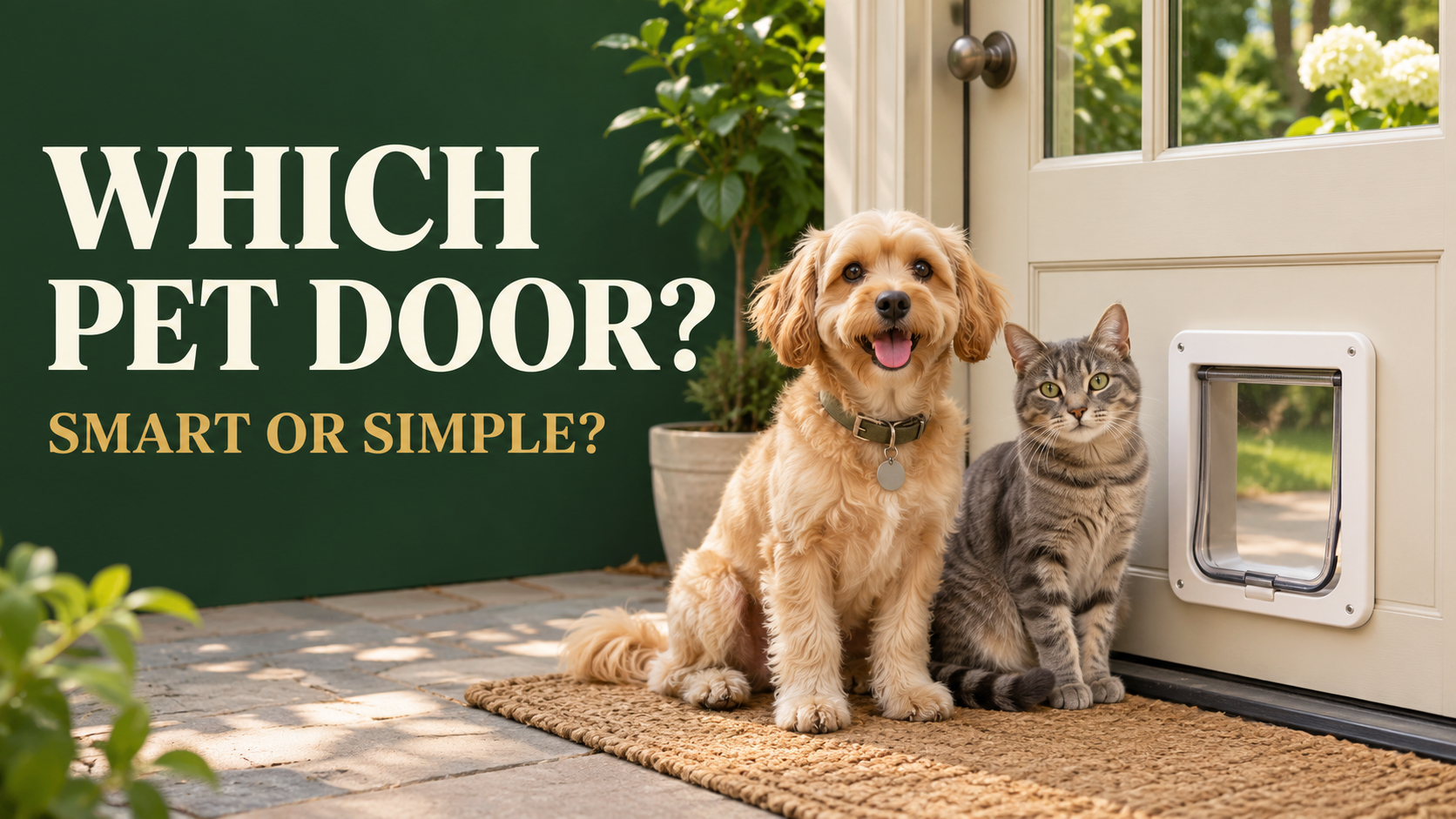
Smart Pet Door Alternatives: Electronic, RFID, or a Sturdy Manual Flap?
SPOIL MY PET • SMARTER HOME CHOICES
Your pet wants out. Then in. Then out again. Before you accept your new position as a full-time doorman, here is how to choose a pet door that actually fits your home.
Affiliate disclosure: As an Amazon Associate I earn from qualifying purchases. If you buy through links in this post, we may earn a commission at no extra cost to you.
The most useful pet door is not necessarily the one with the most electronics. Some homes need selective access. Others need a durable flap with a good weather seal. And sometimes the sensible choice is to keep opening the door yourself.
This guide compares three approaches: a collar-key electronic door, a microchip/RFID door, and a sturdy manual flap. It is based on manufacturer information, not hands-on testing. Check the exact model and size on the listing before buying.

First, “Electronic” and “RFID” Are Not Opposites
RFID is a way of identifying a pet, and an RFID-reading door is electronic too. The practical questions are what identifies your pet, which direction is controlled, and whether the pet pushes the flap or the door opens it.
An electronic lock does not necessarily mean a motorized opening. The PetSafe collar-key and SureFlap models discussed here unlock a flap your pet pushes through.
Pet Doors Compared at a Glance
| Option | How It Works | Main Trade-Off |
|---|---|---|
| PetSafe Electronic SmartDoor | Programmed collar key unlocks the flap in automatic mode | Needs a worn key and batteries |
| SureFlap Microchip Pet Door | Reads a compatible microchip or Sure Petcare RFID tag for entry | Standard model does not selectively identify pets on exit |
| PetSafe Extreme Weather Aluminum | Pet pushes through manual flaps; closing panel blocks access | No selective access while open for use |
1. PetSafe Electronic SmartDoor: Collar-Key Access
PetSafe now calls this model the Electronic Pet Door, formerly the Electronic SmartDoor. In automatic mode, a programmed collar key allows entry and exit. Locked and unlocked modes are also available, and the door supports up to five programmed keys.
A good match for: Households that want collar-key access and are comfortable maintaining the door and key batteries.
Before buying: This is not the same product as the SmartDoor Connected model. Check the model name, opening size, compatible keys, and installation requirements. An implanted identification microchip does not replace the required SmartKey on this model.
Also think about the everyday routine: will the pet keep the key attached, and will someone notice when a battery needs replacing?
View the PetSafe Electronic Door on Amazon →
2. SureFlap Microchip Pet Door: Recognition Without a Powered Collar Key
The standard SureFlap Microchip Pet Door is designed for large cats and small dogs. It recognizes compatible implanted microchips and can also use a Sure Petcare RFID collar tag. The manufacturer includes a compatibility checker to use before buying.
A good match for: Owners who want selective entry for a suitably sized pet, particularly when using an existing compatible microchip.
Before buying: Check the flap dimensions, your pet’s chip compatibility, installation accessories, and whether you need a different model for individual exit control. “Microchip Pet Door,” “DualScan,” and “Connect” are not interchangeable names.
View the SureFlap Door on Amazon →

3. PetSafe Extreme Weather Aluminum: A Sturdy Manual Alternative
This manual option uses an aluminum frame, three flaps, magnetic seals, and a slide-in closing panel. The flaps are vinyl; the frame is aluminum. Its appeal is straightforward access without identification electronics or charging.
A good match for: Owners who prioritize a simple design and weather sealing over individual pet permissions.
Before buying: Any animal that can fit and push through may use it when the closing panel is removed. A thicker flap system may also take more practice for a hesitant pet. Check the opening, door thickness requirements, and replacement-flap availability.
The closing panel helps you block the opening, but do not treat a pet-door panel as a substitute for your home’s security locks.
View the Manual PetSafe Door on Amazon →
Five Checks Before You Cut Anything
- Measure the pet, not just their weight. Compare body width and height with the usable opening. Use a cardboard template to assess fit without forcing your pet through.
- Check the step-over height. The bottom edge needs to be manageable for your shortest or least mobile pet, while installation must follow the manufacturer’s template.
- Match the mounting surface. Doors, walls, glass, screens, and sliding patio panels need different solutions. Do not cut tempered glass; ask a qualified glazier about a suitable replacement panel.
- Plan for power loss. Read the exact model’s low-battery behavior and manual override instructions. Do not assume it will remain unlocked or let your pet return inside.
- Count the full cost. Include extra tags, batteries, tunnels, adapters, replacement flaps, installation, and repairs to the surrounding door.
Renting? Get written permission before modifying a door or wall. For a patio insert, verify how the main door will latch, lock, and seal with the insert installed.
A Pet Door Does Not Make the Yard Safe
Look at what is on the other side: fencing, gates, roads, pools, weather exposure, and local wildlife. Selective access can help manage the doorway, but it does not supervise your pet or guarantee another animal cannot follow closely behind.
For a cat, consider access to a secure catio rather than unrestricted roaming. Keep children’s access in mind too, especially when a flap leads toward a pool or other hazard.
If you also want location tracking, explore our smart dog collar comparison. A tracker serves a different purpose from a door lock and does not replace secure containment.
Help Your Pet Learn the New Door
Introduce the door in short, relaxed sessions. Follow the manufacturer’s training instructions, reward voluntary approaches, and allow time for your pet to adjust to the flap and locking sound. Never push or pull them through.
Before relying on it, watch your pet enter and leave several times. Test every pet and every permission setting. Check that the flap closes properly and that your pet can return inside.
For a broader look at movement and routine, read our guide to dog activity trackers.
Frequently Asked Questions
Does an RFID Pet Door Need Wi-Fi?
Not necessarily. RFID identification and Wi-Fi connectivity do different jobs. Check the specific model if you want app controls, schedules, or remote access.
Will Any Microchip Work With Any Electronic Door?
No. Some doors read implanted chips, while others require a specific collar key. Check the manufacturer’s compatibility information for the exact model.
Can Dogs and Cats Share One Door?
Possibly. The largest pet must fit, the smallest must be able to push through comfortably, and the access settings must suit all of them.
Which Option Needs the Least Electronic Upkeep?
A manual flap has no identification batteries to maintain. It still needs cleaning, seal checks, and occasional replacement parts.
What If I Cannot Modify My Home?
Look into an approved removable patio insert or keep supervised door access. A permanent cutout is not the right starting point if the installation itself is unsuitable.
Choose the Simplest Door That Solves the Problem
Choose collar-key access when permissions matter, microchip entry when compatible identification fits your pet, or a sturdy manual flap when simplicity matters most. Start with fit, installation, and a safe destination outside—then compare features.