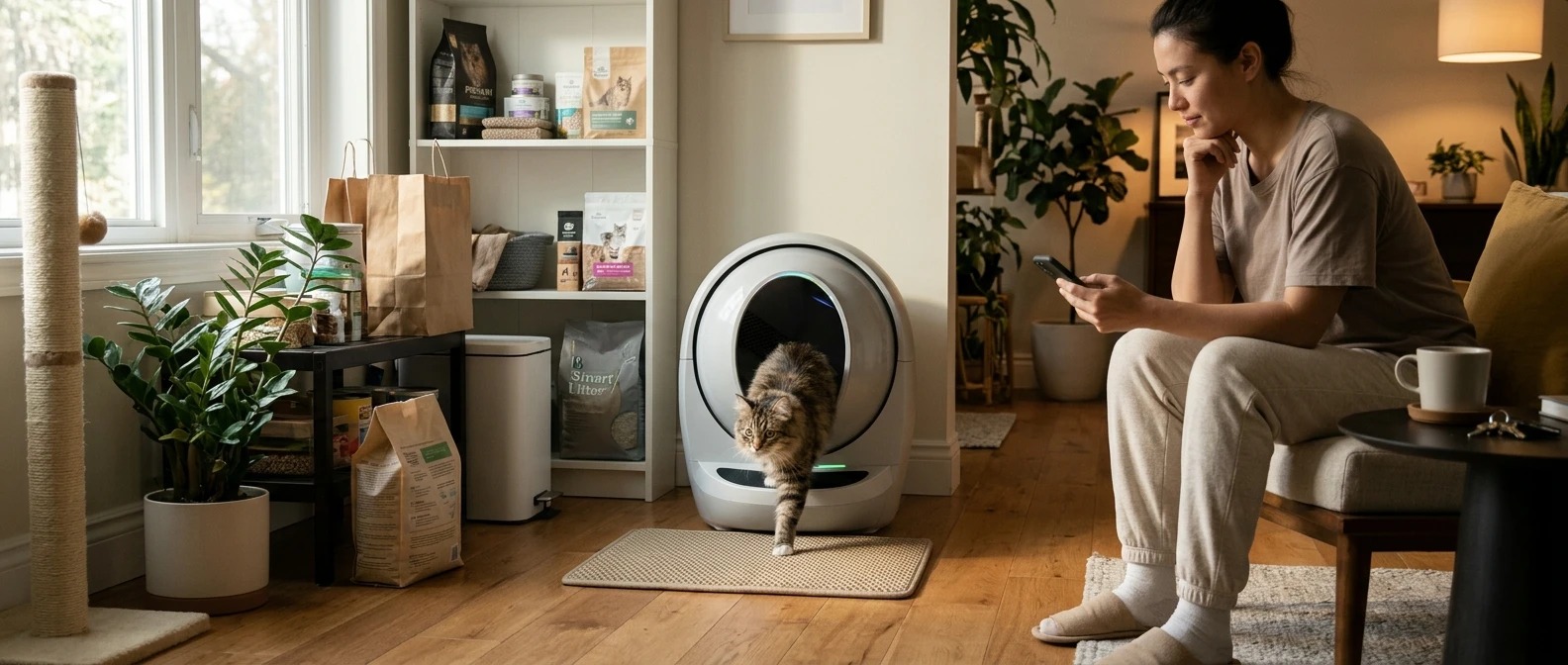
Is a Smart Litter Box Worth the Money? A Cost, Cleanup and Daily-Life Breakdown
SPOIL MY PET • LESS SCOOPING, MORE QUESTIONS
Your cat gets a robot bathroom. You still take out the trash. A smart litter box can reduce daily scooping, but whether it earns its price depends on your cat, your budget, and the cleanup you are willing to do.
The useful question is not “Does it clean itself?” It is “Which chores disappear, which ones remain, and is that trade worth the money?”
This guide compares the cost and routine rather than ranking specific models. Product features vary, and the budget below is an illustration—not a price quote or savings guarantee.

What Changes in Daily Life?
| Task | Manual Box | Automatic Box |
|---|---|---|
| Removing clumps | You scoop | Machine separates waste when operating correctly |
| Disposing of waste | Empty the scoop container or bag | Empty a drawer or replace a tray/bag |
| Washing | Usually fewer parts | May require disassembly and sensor care |
| Daily checks | Litter condition and cat’s habits | Same checks, plus waste level and machine status |
| Unexpected problems | Spills, dirty surfaces, damaged tray | Those issues plus jams, errors, or power problems |
1. Separate “Automatic” From “Smart”
An automatic box moves waste out of the usable litter area. A smart model adds connected features, such as notifications, usage history, or weight estimates. You may want the first without needing the second.
Ask whether cleaning continues without Wi-Fi, which app features require payment, and what happens during a power outage. Do not assume all automatic boxes use the same litter or cleaning mechanism.
2. Calculate More Than the Purchase Price
Include compatible litter, liners or cartridges, filters, odor-control supplies, accessories, electricity, repairs, and any subscription you intend to use. Some models accept ordinary bags; others have more specific consumables.
Also check return shipping, cleaning requirements for returns, warranty coverage, and replacement-part availability. A trial can be valuable, but returning a large used appliance may cost money.
A Sample Budget: One Cat, Two Setups
Illustrative assumptions only: A $40 manual box versus a $700 automatic box; $25 a month for litter in either setup; and an additional $5 a month for automatic-box consumables. Actual costs can be higher or lower.
| Budget Item | Manual | Automatic |
|---|---|---|
| Initial box | $40 | $700 |
| Annual litter | $300 | $300 |
| Annual extra consumables | $0 in this example | $60 |
| First Year | $340 | $1,060 |
| Three Years | $940 | $1,780 |
Excludes tax, shipping, disposal bags for the manual setup, cleaning supplies, electricity, accessories, subscriptions, repairs, and replacements. Assumes unchanged spending and that both boxes last three years.
In this example, convenience costs an extra $720 in year one and $840 across three years. That may be worth it to you, but it is not automatically a money-saving purchase.
3. Be Realistic About Time Saved
If automation saves a net two minutes per day, that is about 12 hours a year. Five minutes per day is about 30 hours. These are arithmetic examples, not measured product results.
Count the time spent emptying the drawer, wiping residue, removing litter from sensors, washing components, drying them, and fixing errors. The benefit may be fewer daily interruptions rather than a dramatic reduction in total cleaning.
If bending or scooping is difficult, reduced daily scooping can be valuable. Still check whether you can reach the waste drawer and lift or wash the larger parts—or arrange help for those tasks.

4. Check Safety Before Convenience
Read the exact model’s manual before buying. Look for clear minimum weight and age requirements, cat-detection and stop/reverse behavior, maintenance instructions, and a reachable manufacturer. Check official recall information and current safety notices for that model.
- Match Your Cat’s Size: Minimum detection weight and usable interior space are different questions.
- Understand the Moving Parts: Look at how access and the exit route change during a cycle.
- Follow Placement Rules: Flooring, clearance, litter level, and sensor cleanliness can affect operation.
- Never Bypass Safeguards: Do not defeat sensors or modify the mechanism to stop an error.
For example, Whisker says Litter-Robot 4 should not operate in automatic mode for kittens under 3 pounds. That is a model-specific restriction, not a universal threshold for other boxes.
Follow only manufacturer-approved checks. Never use your cat—or your hand—to test whether a moving mechanism will stop. If operation seems unsafe, stop using the automatic function and provide a manual box while seeking support.
5. Your Cat Gets the Final Vote
Your cat needs enough room, a manageable entrance, a comfortable litter surface, and a location where another pet cannot block access. A large exterior does not guarantee a roomy interior.
Introduce the new box gradually and keep a familiar, clean box available. Follow the acclimation instructions, supervise early use, and never force your cat inside or deliberately let the old box become dirty to pressure a switch.
In multi-cat homes, one machine’s advertised capacity does not replace the need for accessible choices. Cornell recommends as many boxes as cats, plus one. Keep them in appropriate locations rather than assuming one shared machine suits everyone.
6. Odor and Tracking Do Not Disappear
Moving waste into a drawer may reduce how much remains exposed, but waste is still in the home until you remove it. Drawer seals, litter choice, stool consistency, cleaning, and emptying frequency all affect the experience.
Do not expect a filter to compensate for a dirty machine. Scattered litter can also remain a daily chore. Check the exit design and space for a mat without obstructing access or violating placement instructions.
7. Treat App Data as Clues
Visit counts and weight estimates may help you notice a change, but pet identification can be imperfect, especially with cats of similar weights. A cleaning cycle is not proof that a cat passed urine normally.
Continue observing your cat and the waste. Connected features also bring account and privacy settings to review. Our activity-tracker guide explains the broader difference between wellness observations and medical answers.
When Is It Worth the Money?
More Likely Worthwhile: Daily scooping is a significant burden, your cat accepts the model, you have the space, and supplies and repairs fit your budget.
Less Likely Worthwhile: Your cat dislikes the enclosure or noise, parts are hard to clean, support is unclear, or the purchase would strain your finances.
Before Ordering: Measure the space, read the manual, calculate consumables, inspect the return terms, and decide where the backup manual box will go.
Frequently Asked Questions
Does “Self-Cleaning” Mean I Never Wash It?
No. Automatic waste removal does not wash the unit. Follow the cleaning schedule and inspect it daily.
Can I Use Any Litter?
No. Some machines need specific clumping litter, crystals, pellets, or trays. Check compatibility before buying supplies.
Can I Leave It Unattended for Several Days?
Do not use automation as a substitute for a caregiver. Someone should check the cat, water, food, and litter setup and handle faults or a full drawer.
Will It Save Money on Litter?
Possibly, but usage varies. Do not count on savings until you compare actual consumption, consumables, and maintenance costs.
Buy Less Scooping—Not a Promise of No Work
A smart litter box can make daily life easier when the fit is right. Choose for safety, your cat’s comfort, and the maintenance you can sustain. A clean manual box is still a good solution.
Keep Comparing Pet Tech
Explore more buying questions at Spoil My Pet. If you also use connected collars, our smart collar comparison shows why fit, running costs, and useful features matter more than the word “smart.”